Recall the first aid measures specific to survivors of sexual violence.
Explain the significance of informed consent and its role in survivor-centred care.
Apply trauma-informed communication techniques when obtaining history from survivors.
Choose the most appropriate evidence collection methods based on the survivor's history and the circumstances of the assault.
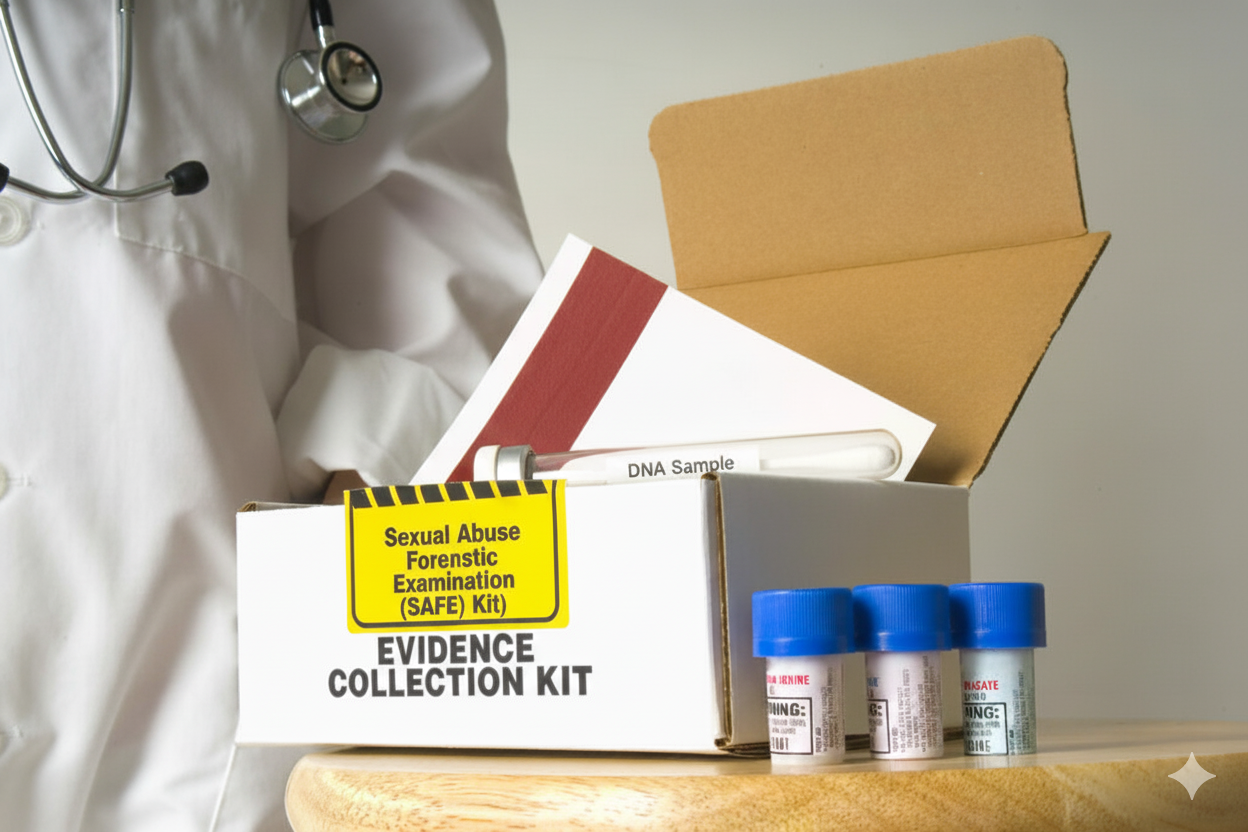
Perform a complete head-to-toe medical examination for survivors of sexual violence, ensuring systematic assessment, proper documentation, and adherence to legal, ethical, and forensic standards.
Formulate provisional and final clinical opinions by synthesising the survivor's history, clinical findings, and forensic evidence collected during the medical examination.
improve learners competence, improve learners performance, improve patient outcomes
andrology, auxiliary nurse and midwives, community health nursing, community medicine, emergency and disaster nursing, emergency medicine, family medicine, forensic medicine, general medicine, mental health nursing, nursing, obstetric and gynecological nursing, obstetrics/gynecology, paediatrics, psychology, public health, social work, toxicology, urology, women's health
advanced practice nurse, child and adolescent psychiatrist, family physician, intern/resident, nurse, obstetrics and gynaecology (OB/GYN) surgeon, pathologist, physician assistant, physician/doctor, psychiatrist, psychologist, specialist in emergency medicine, specialist in forensic medicine and toxicology, specialist in general medicine, specialist in obstetrics and gynecology, student
Accreditation in progress
Accrecent requires all individuals in control of educational content to disclose financial relationships with ineligible companies from at least the past 24 months, preferably from the time of their graduation. All relevant relationships from planners, editorial staff, authors, and peer reviewers have been disclosed, reviewed, and appropriately mitigated in accordance with ACCME Standards.
Ineligible companies are defined as organisations whose primary business is producing, marketing, selling, re-selling, or distributing healthcare products used by or on patients.
Emma Van Hoecke, the founder of Accrecent, has no relevant financial relationships to disclose.
All other team members of Accrecent involved in the development or review of this content have no relevant financial relationships to disclose.
The financial disclosure status of all authors and peer reviewers is provided in the "Authors & Peer Reviewers" section of this activity.
Author
Dr. Choitali Goswami
MD (Forensic Medicine & Toxicology)
Dr. Choitali Goswami is an assistant professor at the Department of Forensic Medicine and Toxicology at JIS School of Medical Science and Research. She has received training on 'Forensic examination of sexual assault cases' from the National Institute of Criminology and Forensic Science, New Delhi. She brings extensive experience in medicolegal practice, including conducting autopsies, delivering lectures and practical training to undergraduate medical students, performing medico-legal examinations, and serving as an expert witness in court proceedings. Her research contributions in the field are available on her ResearchGate profile.
Mitigation: Not applicable
Peer reviewer
Dr. Jacinth Karunya
Assistant Professor, Department of Forensic Medicine
Andhra Medical College, Visakhapatnam
Dr. Jacinth Karunya Midde is a forensic healthcare professional and medicolegal expert with extensive experience in autopsy techniques, death investigation, and academic leadership. Currently serving as an assistant professor at Andhra Medical College, aligning with the Competency-Based Medical Education (CBME) curriculum. His teaching covers forensic pathology, medicolegal aspects of clinical practice, and hands-on autopsy training.
He previously served as Assistant Professor at Bhaskar Medical College, Hyderabad, and as Senior Resident at GITAM Institute of Medical Sciences and Research, Visakhapatnam.
Mitigation: Not applicable
Dr. Jacinth Karunya
Assistant Professor, Department of Forensic Medicine
Andhra Medical College, Visakhapatnam
Dr. Jacinth Karunya Midde is a forensic healthcare professional and medicolegal expert with extensive experience in autopsy techniques, death investigation, and academic leadership. Currently serving as an assistant professor at Andhra Medical College, aligning with the Competency-Based Medical Education (CBME) curriculum. His teaching covers forensic pathology, medicolegal aspects of clinical practice, and hands-on autopsy training.
He previously served as Assistant Professor at Bhaskar Medical College, Hyderabad, and as Senior Resident at GITAM Institute of Medical Sciences and Research, Visakhapatnam.
Mitigation: Not applicable

 Duration:
01:00 hour
/
Duration:
01:00 hour
/
 Fee:
FREE
Fee:
FREE

 Comments (74)


 Share
Share
 Email
Email
 4.7
4.7